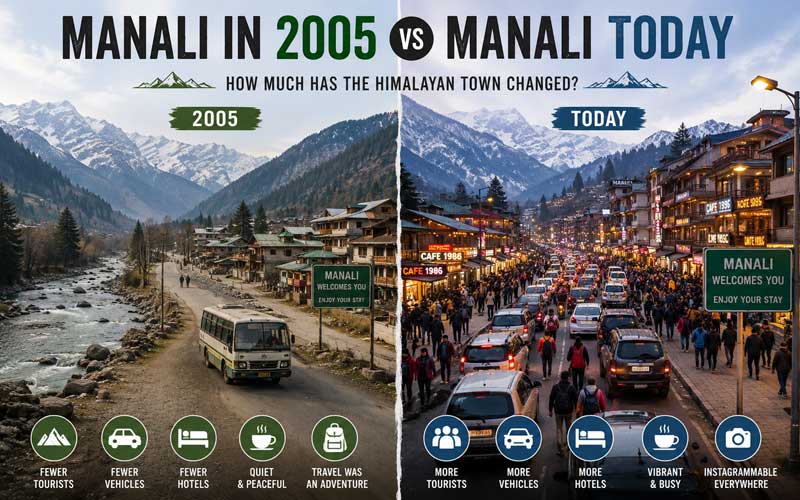
Manali has always had a special place in the hearts of travelers. Surrounded by snow-covered mountains, pine forests, rushing rivers and dramatic Himalayan landscapes, it was once considered a peaceful escape for backpackers, honeymooners and families looking for a break from city life.
But Manali today can feel very different from the Manali many travelers remember from the early 2000s.
If we travel back to 2005, the town was smaller, quieter and considerably less commercialized. There were fewer vehicles, fewer hotels, fewer cafes and far fewer tourists during most parts of the year. Traveling to Manali itself was part of the adventure.
Fast-forward to today, and Manali has transformed into one of India's most popular mountain destinations. Better roads, more accommodation, improved connectivity, social media, adventure tourism and a rapidly expanding hospitality industry have changed the character of the destination.
So, what exactly has changed?
Let's take a nostalgic journey from Manali in 2005 to Manali today.
1. The Atmosphere: From Quiet Mountain Escape to Busy Tourist Hub
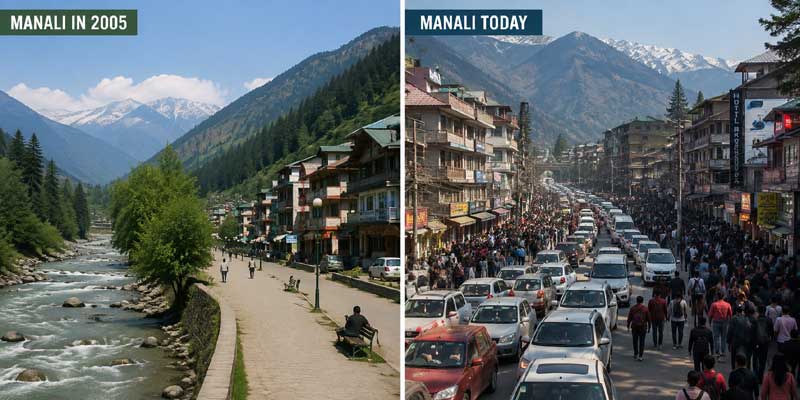
Perhaps the biggest difference is the atmosphere.
In 2005, Manali had a much slower pace. The town was certainly popular, but compared with today's tourist volumes, it felt considerably less crowded. Walking around Mall Road or Old Manali could feel relaxed, particularly outside the busiest holiday periods.
The surrounding landscape also appeared to dominate the experience. Travelers could spend hours simply sitting beside the Beas River, walking through pine forests or exploring nearby villages.
Today, Manali is much more energetic.
Tourists arrive throughout the year, with particularly heavy crowds during summer, winter snowfall periods and long weekends. Roads can become congested, parking is a major concern and popular attractions frequently see large numbers of visitors.
The transformation has brought economic opportunities to local businesses, but it has also changed the peaceful character that attracted many travelers in the first place.
2005: Peaceful, slower and less crowded.
Today: Vibrant, busy and highly commercialized.
2. Getting to Manali: The Journey Has Changed
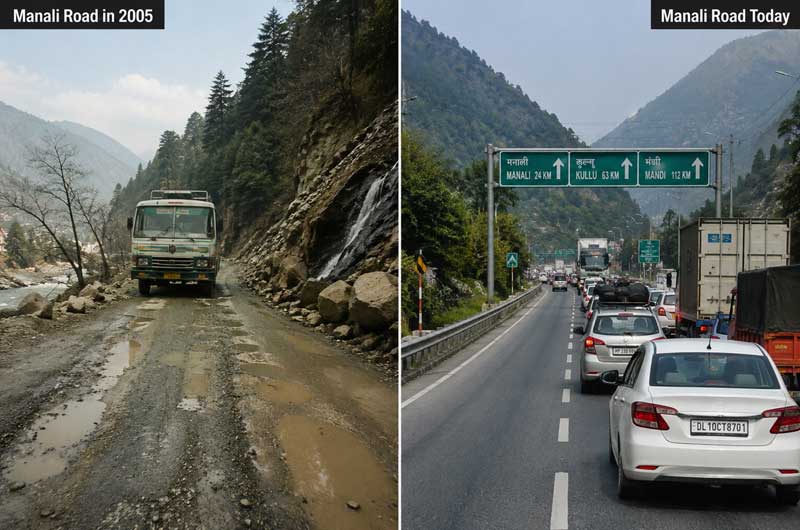
In 2005, reaching Manali by road was itself an experience.
Travelers coming from Delhi or Chandigarh typically faced long journeys on mountain roads. Road conditions varied considerably, and sections of the journey could be slow, rough and unpredictable.
A road trip to Manali could take much of a day, and delays caused by weather, traffic, road construction or landslides were common.
Today, the journey is considerably more comfortable in many sections.
Highway improvements, tunnels, bridges and road upgrades have made parts of the route faster and smoother. The opening and development of major infrastructure projects around the region have also changed travel patterns.
However, better roads have produced another problem: more vehicles.
During peak tourist seasons, traffic entering and leaving Manali can become extremely heavy. A journey that is faster under normal conditions can still become painfully slow during a holiday weekend.
So the transformation is not simply "better roads = shorter journeys." It is also a story of dramatically increased demand.
3. Accommodation: From Guesthouses to Luxury Resorts
Manali's hospitality industry has expanded enormously.
Back in 2005, travelers had plenty of guesthouses, small hotels, budget properties and traditional accommodation options. Backpackers could find simple rooms without the enormous variety of choices available today.
Old Manali in particular became famous for its relaxed guesthouses and backpacker-oriented atmosphere.
Today, visitors can choose from virtually every category of accommodation.
There are budget hostels, homestays, boutique hotels, luxury resorts, villas, cottages and premium properties offering mountain views and modern amenities.
Online booking has also completely changed the process.
In 2005, travelers commonly relied on travel agents, telephone bookings, recommendations from friends or simply walked around looking for a room.
Today, travelers can compare dozens of properties, photographs, reviews and prices before leaving home.
The result is greater convenience—but also a much larger construction footprint.
4. Mall Road: Then and Now
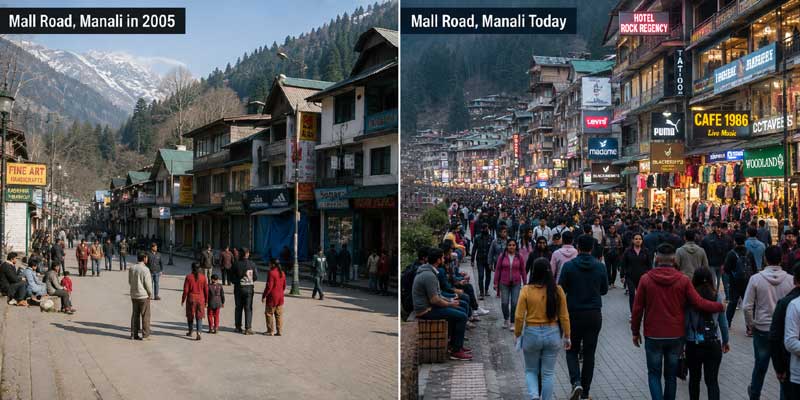
Mall Road has always been one of Manali's most recognizable areas.
In 2005, it was already an important commercial center, but the shopping experience was more modest. There were local shops, small restaurants, woollen clothing stores, handicraft sellers and businesses catering primarily to tourists.
Today, Mall Road is significantly busier and more commercial.
The number and variety of restaurants, cafes, clothing stores, souvenir shops and branded businesses have increased. Tourists often gather here in large numbers, particularly during peak season.
The Mall Road experience has therefore evolved from a relatively simple mountain-town shopping street into a major tourist attraction in its own right.
For some visitors, this means more entertainment and choices.
For others, it means losing some of the old-world charm.
5. The Food Scene Has Exploded
Food is another area where the transformation is obvious.
In 2005, visitors could enjoy traditional Himachali dishes, North Indian food, basic Chinese-style meals, Tibetan food and the increasingly popular cafe culture of Old Manali.
Today, Manali's food scene is far more diverse.
A traveler can find Indian, Tibetan, Italian, Israeli, Korean, Continental and fusion food alongside traditional Himachali cuisine.
Cafes have become an important part of the Manali experience.
Old Manali, in particular, has developed a strong cafe and backpacker culture, with travelers spending hours working, socializing, listening to music or simply enjoying mountain views.
The positive side is enormous choice.
The challenge is making sure traditional local cuisine doesn't disappear beneath an increasingly globalized tourist menu.
6. Adventure Tourism Has Transformed Manali
Manali was never just about sightseeing, but adventure tourism has grown dramatically.
In 2005, travelers could enjoy trekking, river activities, paragliding around Solang Valley and other outdoor experiences. However, the range and scale were relatively limited.
Today, Manali has become a major adventure tourism hub.
Depending on the season and regulations, visitors can encounter activities such as river rafting, paragliding, skiing, snow activities, mountain biking, trekking, camping, ziplining and other adventure experiences.
Nearby destinations have also become much more accessible to tourists.
The growth of adventure tourism has created employment and business opportunities, but it has also increased pressure on roads, waste management and fragile mountain environments.
7. The Environment: The Biggest Concern
This may be the most important part of the comparison.
Manali's natural beauty remains its biggest attraction—but that beauty is under pressure.
In 2005, the Beas River, surrounding forests and mountain landscapes generally felt less affected by the scale of tourism that exists today.
That doesn't mean Manali was untouched or perfectly clean. Environmental challenges existed then too.
But the number of visitors, vehicles, buildings and commercial establishments has increased substantially.
More tourism means more waste, sewage, water consumption, traffic and construction.
Plastic waste and congestion can become especially visible during peak tourist periods.
At the same time, environmental awareness has also increased.
Local communities, businesses, travelers and authorities are increasingly discussing responsible tourism, waste reduction, river conservation and sustainable development.
The future of Manali may therefore depend on finding the balance between tourism growth and environmental protection.
8. Local Culture and Lifestyle
Manali's local culture remains one of its greatest strengths.
Traditional Himachali architecture, food, clothing, festivals and village life continue to exist alongside modern tourism.
But the pace of life has changed.
In 2005, tourism was an important part of the economy, but many areas retained a stronger small-town character. Personal interactions between visitors and local residents often felt slower and more informal.
Today, tourism has become a much larger economic force.
Businesses operate at a faster pace, online bookings and digital payments are standard, and social media has transformed how travelers discover places.
The local population has also adapted to a more connected and commercially active tourism economy.
The culture hasn't disappeared—but it now exists alongside a much larger tourism ecosystem.
9. The Cost of Traveling to Manali
Manali was once considered a relatively affordable Himalayan destination.
Budget travelers could manage accommodation and food at comparatively modest prices, particularly by choosing guesthouses and eating at local establishments.
Today, there is a much wider range of prices.
Budget travel is still possible, especially through hostels, homestays and local restaurants. But visitors looking for premium hotels, resorts, private transport and adventure activities can spend considerably more.
The important difference is that Manali now caters to almost every budget.
A backpacker and a luxury traveler can visit the same destination while having completely different experiences.
Prices also fluctuate dramatically depending on season.
Summer holidays, New Year, snowfall periods and long weekends can push accommodation and transport costs significantly higher.
10. Technology Has Completely Changed the Travel Experience
Perhaps the biggest invisible change is technology.
Imagine visiting Manali in 2005 without Google Maps, Instagram, YouTube travel videos, online hotel reviews or instant digital payments.
Travel planning required more research, phone calls, travel agents, guidebooks and recommendations.
Today, a traveler can discover a hidden cafe on Instagram, book a hotel from a smartphone, navigate using GPS, pay digitally and upload photographs within minutes.
Social media has also turned Manali into a highly visual destination.
A scenic road, cafe, waterfall or mountain viewpoint can suddenly become popular after appearing in a viral video.
This has helped local businesses reach millions of potential visitors—but it can also send large crowds toward places that were never designed to handle them.
11. Old Manali: A Symbol of the Transformation
If one part of Manali represents this transition particularly well, it is Old Manali.
The area became known for its relaxed atmosphere, guesthouses, cafes, backpackers and traditional surroundings.
Over the years, tourism expanded.
More cafes, hotels, shops and accommodation appeared, while the area became increasingly popular with domestic and international travelers.
Yet Old Manali still retains elements of the atmosphere that made it famous.
Walk far enough away from the busiest streets and you can still encounter forest paths, mountain views, traditional houses and quieter corners.
That contrast is perhaps the story of Manali itself.
Modernity has arrived—but the mountains remain.
12. What Has Manali Gained?
The transformation has brought many benefits.
- Better infrastructure has made travel easier.
- More hotels have created accommodation choices.
- Tourism has generated employment and business opportunities.
- Adventure tourism has created new activities.
- Restaurants and cafes have expanded the culinary experience.
- Digital technology has made planning easier.
- And Manali has become accessible to far more people than it was two decades ago.
For many families and young travelers, this accessibility is a positive development.
13. What Has Manali Lost?
But development comes with a price.
- Some of the quietness has disappeared.
- Traffic has increased.
- Construction has expanded.
- Popular areas can feel overcrowded.
- Natural resources face greater pressure.
- The traditional character of certain areas has been diluted by commercialization.
For travelers who remember Manali in 2005, these changes can be particularly noticeable.
The question isn't whether Manali should develop.
The real question is how it should develop.
Manali in 2005 vs Manali Today: The Bigger Picture
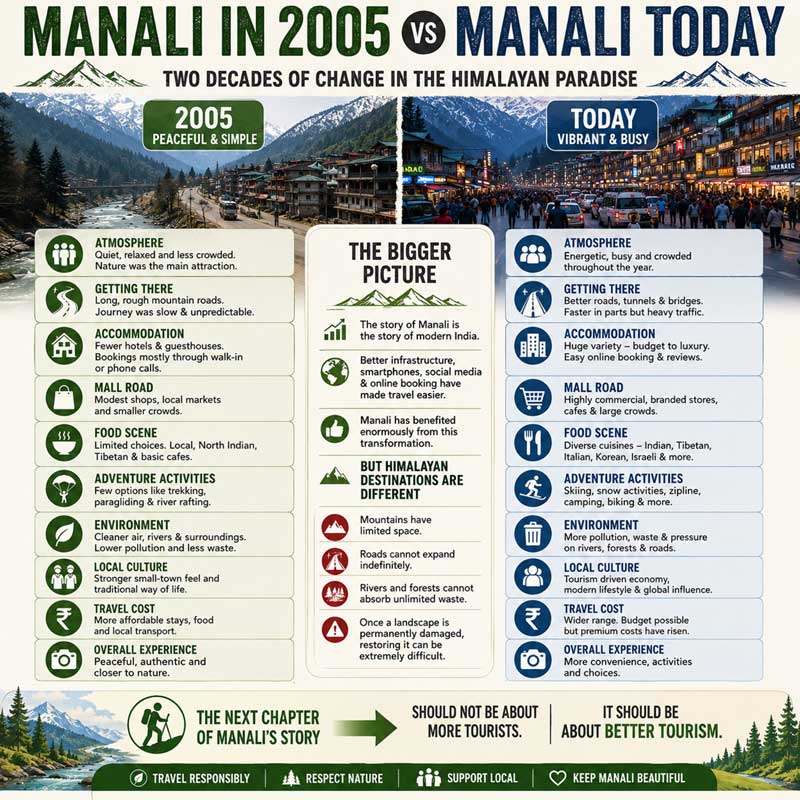
The story of Manali is actually a story of modern India.
Two decades ago, domestic tourism was already growing, but travel information was harder to access and reaching remote destinations required more effort.
Today, rising incomes, better infrastructure, smartphones, social media and online booking have made travel dramatically easier.
Manali has benefited enormously from that transformation.
But Himalayan destinations are different from ordinary cities.
Mountains have limited space.
Roads cannot expand indefinitely.
Rivers and forests cannot absorb unlimited waste.
And once a landscape is permanently damaged, restoring it can be extremely difficult.
That is why the next chapter of Manali's story should not simply be about more tourists.
It should be about better tourism.
The Manali We Should Preserve
The Manali of 2005 may never return—and perhaps it shouldn't.
The town has changed because India has changed.
People want better hotels, better roads, better connectivity and more experiences.
Businesses need tourism to grow.
Travelers want convenience.
But the reason people come to Manali in the first place hasn't changed.
- It is the mountains.
- It is the Beas River.
- It is the pine forests.
- It is the snow.
- It is the villages.
- It is the fresh mountain air.
- And it is the feeling of being surrounded by the Himalayas.
If development destroys those things, Manali risks becoming another crowded tourist town instead of the extraordinary mountain destination that made it famous.
The goal, therefore, should not be to recreate 2005.
It should be to build a better Manali for 2030, 2040 and beyond—one where tourism and nature can exist together.
Final Thought
Manali in 2005 was quieter. Manali today is more connected, more developed and more exciting.
Both versions have their own charm.
The challenge for the future is to make sure that modernization doesn't erase the very landscape and culture that brought travelers here in the first place.
Because Manali can change.
Hotels can change.
Roads can change.
Technology can change.
But the mountains should remain.
Manali has changed dramatically in two decades. The question now is: how do we make sure it changes responsibly?